Entry Level: BioTech
Developing A Protocol
Simulation vetted by professionals from a biotech start-up in Greater St Louis
Start-Up Job Title:
Research Associate
Associated Simulation Library:

Background
A large part of doing research is experimental design. This can include establishing methods and protocols that can be used for experiments, learning the best ways to operate new equipment, and deciding what chemicals or reagents to use, for example. With this, it’s necessary to be patient and have an exploratory mindset while getting started.
A large part of developing protocols that can be used for future experiments is knowing what work has been done previously and testing it out for yourself. A literature search is a key task to be comfortable with to do just that. A literature search is a comprehensive process of identifying and retrieving relevant academic and professional publications on specific topics. In the lab, it’s common to search and read through scientific papers. Knowing how to find good scientific papers and reading through them will help make the searches more efficient and productive.
Literature searches are performed to:
Gain background knowledge on a particular topic
Find evidence to support hypotheses
Learn different approaches/experiments to answer a question (molecular techniques vs imaging, etc…)
Stay up to date on new findings within the field
Identify what’s not currently known (gaps in the field)
Avoid reinventing the wheel; identify what has already been done
Everyone in a lab needs to know how to do a comprehensive lit search: lab technicians, lead scientists, primary investigators–everyone! Lit searches are used across all scientific and academic disciplines, thus being comfortable with it is a necessary and useful skill.
-
summary of the paper that includes the research question, a brief overview of the method, and results.
-
A searchable title that summarizes the paper and list of people who contributed to the work (experiments, funding, and writing).
-
Includes relevant background information for the topics explored in the paper with references to work cited.
-
Detailed notes on the experimental setup, reagents, and equipment used for all experiments in the paper.
You can find protocols within the methods sections of papers or by looking up publications on actual protocols.
-
Report on the findings and the data. Figures, graphs, and tables in this section show the experiments performed, data that were collected and results of the analysis.
-
Interpretations of the results, summary of findings and possible impact on the field, and considerations of future work.
-
List of other work that was cited or referred to in the paper.
Anatomy of a Scientific Paper
(expand each entry for full definition)
The Process
Identify the goal for the literature search (learn new methods, find other data that supports my own findings, etc). Decide how much time you want to spend on finding papers.
Create keywords to search for to help identify papers. Break down the keywords based on methods and topic.
Search the keywords in a database. Scan through papers (mostly the abstract) and select a few that appear to answer your question or goal. This may take some time.
Evaluate the quality of the paper. Cross reference with number of citations or authors, legitimate journals.
Carefully read through the papers and take notes as necessary.
Optional: save the papers in a reference manager or create a list. Add the notes or keywords that stuck out to you for each paper. This can make it easier to go back to in the future.
Resources
Startup Culture
Starting a Wet Lab: Tips for Startup in the Biotech Industry blog (Genie Scientific) - “Lab Management” Section at the bottom
Literature searches and papers
How to Search for Relevant Literature FAST Using Boolean Operators video (Scribbr)
How to Use PubMed video (Biology Professor)
Scientific Papers eBook (Nature) - parts of a scientific paper
Cell types and cell reprogramming
How to Reprogram Fibroblasts into iPS Cells video (STEMCELL Technologies) - example of protocol and experimental workflow
What the HEK? A Beginner’s Guide to HEK293 cells podcast (Bitesize Bio)
Your Role
You are a laboratory technician at a startup lab and you're tasked with creating a new protocol. As part of your role, you do routine cell culture maintenance, cell counting, and cell reprogramming. The lab needs to develop a new HEK (human embryonic kidney) cell reprogramming protocol.
The Exercise
The goal of your project is to reprogram HEK cells. Perform a literature search to find publications where others have successfully reprogrammed cells similar to HEK cells, but not STEM cells. Lots of different stem cell types have been reprogrammed, but it’s a novel approach to reprogram terminally differentiated cell lines. Different cells need different chemicals, so some research needs to be done to see what chemicals to use. Find 3-4 papers, identify the methods for each and create a list that includes each paper.
Task 1 - Identify the keywords for a search related to reprogramming cells
First, jot down the keywords you’ll use in your searches. You may need to skim a few papers to narrow this down. You might use a generative AI platform to provide suggestions, but always go to the primary source (aka original papers) to confirm what has been suggested. Once you have identified a few good keywords related to the instructions, move to task 2.
Here are popular databases to get you started:
PubMed - a free search engine and database of references and abstracts on life and biomedical sciences. The United States National Library of Medicine (NLM) at the National Institutes of Health (NIH) maintains PubMed. It is a highly respected resource used by researchers, healthcare professionals, and students to find scientific studies, clinical trials, reviews, and other types of articles related to medicine, healthcare, and related fields. PubMed includes over 30 million citations and abstracts, providing comprehensive coverage of biomedical literature.
Google Scholar - a freely accessible web search engine that indexes the full text or metadata of scholarly literature across an array of publishing formats and disciplines. It provides a simple way to broadly search for scholarly materials, including articles, theses, books, conference papers, patents, and legal opinions. Google Scholar includes peer-reviewed papers, theses, books, abstracts, and articles from academic publishers, professional societies, online repositories, universities, and other web sites. It's widely used by researchers, students, and academics for finding and accessing scholarly information.
ResearchGate - a professional network for scientists and researchers to share publications, ask and answer questions, and find collaborators. It increases the visibility and impact of research, facilitates networking and collaboration, and provides access to a wide array of research efforts. Researchers, academics, and industry professionals use it to engage with peers and stay updated on developments in their fields.
Task 2 - Using the keywords, identify 3-4 papers that look promising
Now, look for papers that appear to cover the topics you are interested in. List the papers and jot down notes on why they are worth reading. You will share this list with your internship manager and compare notes. Remember to compare them back to the instructions.
Task 3 - List out the cell types and chemical cocktails used for each paper
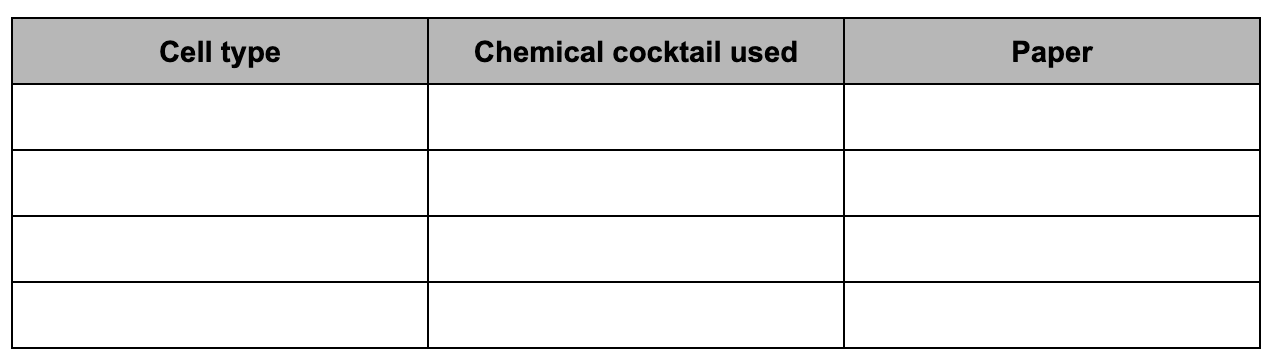
Thoroughly read through each paper. Jot down the types of cells that were used in each and the chemicals used to reprogram the cells. A chemical cocktail is the combination and concentrations of the reagents and chemicals listed in the protocols and methods sections or manufacturer product pages.
You might create and share a table like this:
Deliverables
After a thorough search, you might return a list or table of the papers you read to your project leader. This might include the cell types, and chemical cocktails used. You may go a step further and design experiments similar to what you found from other studies and test the methods yourself.
Additional Tasks
A professional in the field of Laboratory Technician may also perform these tasks:
Cell culture maintenance
Chemical and supplies ordering
Data presentations
Supporting digital infrastructure - where and how is data stored (notebook, excel, databases, locations)
Prepping DNA- tissue type and cell types
Safety training - personal, environmental, and experimental
Cleanliness - keeping bench clean and non-contamination
Hazardous materials - BSL2, hepatitis vaccine
Maintain lab records
Prepare solutions
Depts - Molecular and microbiology; biology; genomics and genetics; tissue procurement; neurology and neuroscience; cell biology; pathology and immunology (basic science depts); bioengineering
Skills Used to Perform this Task
Biotechnology Skills
Willingness to ask questions and get clarifications
Volume calculations for small dilutions
Proper use of the following equipment: micropipettes and small tubes,, potentially gel electrophoresis chamber and gel imager
Following documentation requirements
Aseptic technique
Open-minded and curious
Systematic, repetitive, consistent mindset
Attention to detail
Cleanliness and organization
Skills Used When Working at a Start-Up
Confidence to ask questions when uncertain
Presentation skills & putting data into a presentable format - Microsoft Powerpoint, spreadsheets, or lab notebook, or written reports
Being both collaborative and independent
Flexibility in doing different tasks
Handwriting and legibility
Accountability
Responsible and self-starter
Career Progression
Research associate/technician I, II or Research lab technician I, II > Senior research technician
Sample Job Postings
Typical Pay Range: $16-25/hr
WashU
Research Laboratory Technician I | Pay rate: $16-22/hr
Research Laboratory Technician II | Pay rate: $16-25/hr
Danforth Plant Science Center
Laboratory Technician | Pay rate: $17-20/hr
Sample Job Posting: Research Laboratory Technician
Scheduled Hours 37.5
Position Summary Our lab studies regeneration in aquatic segmented worms, such as the marine annelid Platynereis dumerilii, and freshwater annelid Pristina leidyi.
The successful candidate will perform their independent project under the PIâ™s supervision, assist the PI with experiments and with performing general lab and animal culture maintenance tasks.
Job Description
Primary Duties & Responsibilities
• Help PI with microinjections.
• Carry out confocal imaging for experiments and injected samples.
• Carry out image analysis and prepare figures.
• Help maintain injected animal cultures (breeding, feeding, genotyping, fixing).
• Carry out other molecular biology tasks such as preparing in vitro mRNA, in situ hybridization experiments.
• Perform other duties as assigned.
Working Conditions
This position works in a laboratory environment with potential exposure to biological and chemical hazards. The individual must be physically able to wear protective equipment and to provide standard care to research animals.
Applicant Special Instructions
Documents to be included in the application:
• A cover letter explaining your career goals and why you want to work with us.
• A CV or academic resume.
• Unofficial transcripts.
• Contact information of three references.
Preferred Qualifications
• B.A./B.S. in biology, cell and molecular biology, developmental biology, or a related field.
• Molecular biology (e.g., PCR, genotyping, running DNA gels, preparing solutions). It is critical that the candidate is able to make calculations for preparing solutions, figuring out concentrations, etc.
• For any other skills required for the position, training will be provided by the lab members and/or by the PI.
Required Qualifications
High school diploma or equivalent high school certification.